
Appling County Criminal Court Records
A criminal court record is the file the court keeps after a prosecutor files a charge in court. In Appling County, the full criminal case file is different from an arrest record, booking record, jail roster entry, or police incident report. The case file can include the formal charge, docket, arraignment entry, plea, motions, orders, hearing notices, verdict or plea outcome, disposition, sentence, probation entry, restitution, fine, and appeal notice.
Georgia's court structure controls where Appling County criminal court records are found. Superior Court is the general-jurisdiction court and has felony jurisdiction. Appling is part of the Brunswick Judicial Circuit, so several Superior Court judges have circuit offices outside Baxley while the local clerk keeps the Appling file. State Court is the researched route for county misdemeanors and county traffic citations. Magistrate Court may hold first-appearance, bond, warrant, and preliminary material before a case moves into State or Superior Court.
The State Court source image comes from the Appling clerk State Court page, which lists the State Court judge and solicitor for misdemeanor and traffic-related court work.
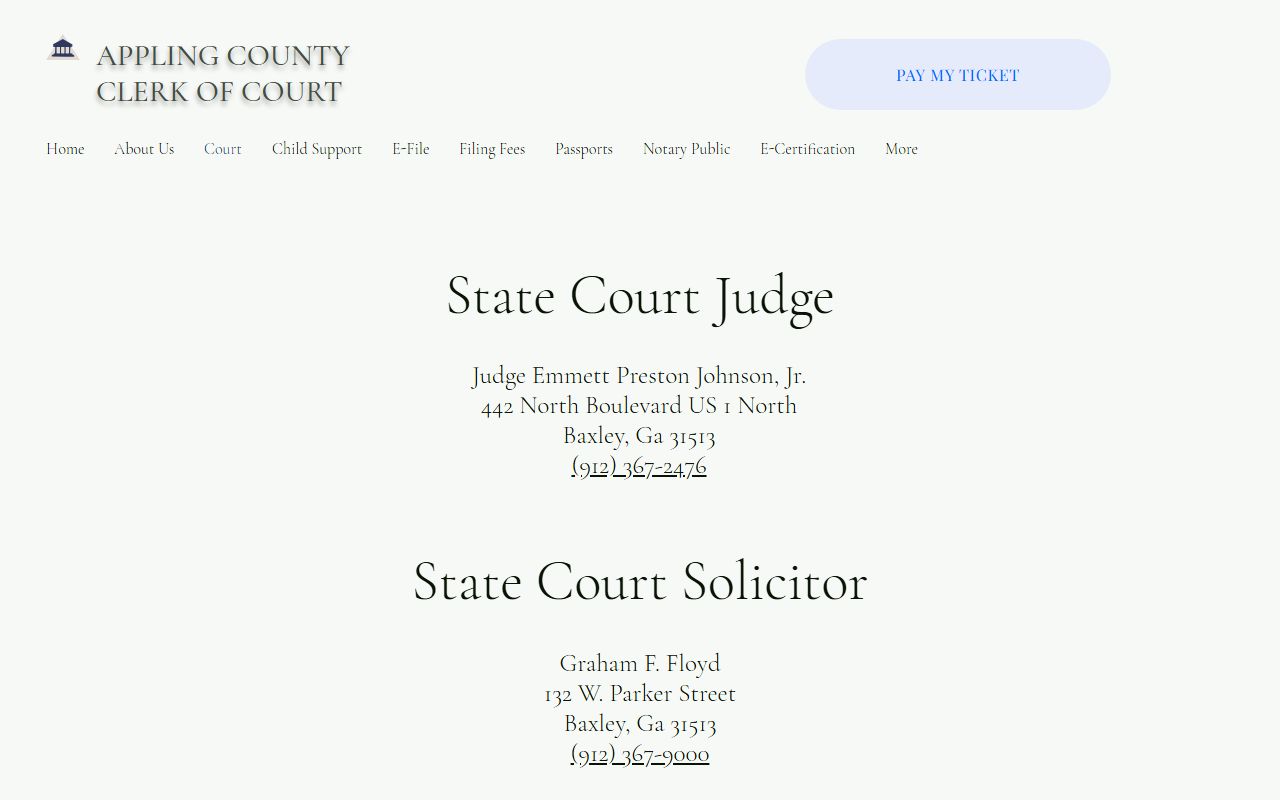
That local State Court role is why misdemeanor criminal court records should not be searched only through a felony Superior Court lens.
Search Appling County Criminal Court Records
The official online path starts with the Georgia Courts e-access list, where Appling State and Appling Superior are listed as provider entries. The state page says account access is required after redirect. The Appling clerk identifies PeachCourt for Superior, State, civil, and juvenile e-filing and document access. No free official Appling-wide criminal case database was located in the research, so the clerk remains the fallback for case lookup, copies, and certified dispositions.
- Identify whether the matter is felony Superior Court, misdemeanor State Court, traffic-related State Court, or preliminary Magistrate Court.
- Use the Georgia Courts e-access Appling State or Appling Superior entry for online provider access.
- Sign in or register if the provider requires an account before case details display.
- Search by defendant name, case number, citation number, court type, and approximate filing year.
- Read the docket for charges, pleas, hearings, disposition, sentence, probation, or appeal entries.
- Request a certified disposition or judgment from the Clerk of Superior, State, and Juvenile Court if a formal copy is needed.
For charges before or around the point a case opens, the related Appling County arrest records and court charges page follows the arrest-to-filed-charge path.
Appling County Criminal Case Flow
The case record grows as each step is filed or entered. A felony may begin with an arrest warrant, first appearance, bind-over, indictment, or accusation, then move through arraignment, motions, plea or trial, disposition, sentencing, probation, and appeal. A misdemeanor can move through State Court with an accusation, arraignment or appearance, plea, hearing, sentence, fine, probation, dismissal, or other disposition. The docket is the map; the filed documents are the detail behind it.
Case flow: Charges Filed › Arraignment › Pretrial / Motions › Plea or Trial › Disposition › Sentencing
| Stage | What Happens |
|---|---|
| Charges filed | The prosecutor files an accusation, indictment, or other charging paper that opens or advances the court case. |
| Arraignment | The charge is addressed in court and a plea such as guilty, not guilty, or nolo contendere may be entered. |
| Pretrial / motions | Parties file requests for rulings, evidence issues, continuances, bond review, or other pretrial action. |
| Plea or trial | The case is resolved by plea, bench trial, jury trial, dismissal, nolle prosequi, or another court action. |
| Disposition | The record states the case or charge outcome, such as guilty, dismissed, dead docket, acquitted, or nolle prosequi. |
| Sentencing | The court records jail, prison, probation, fines, costs, restitution, or other punishment after conviction. |
What Appling County Criminal Records Show
Appling County criminal court records may show more than the charge name. The record can show the court, defendant, prosecutor, attorney, judge, filing date, charge, arraignment, plea, motions, orders, hearings, verdict, sentence, financial terms, probation entries, appeal notices, and restriction or sealing activity. The online research did not reveal a free sample Appling case without account access, so the inventory below follows the researched local record fields and Georgia criminal docket practice.
| Field | What It Shows |
|---|---|
| Case number | The criminal case identifier used by Superior Court, State Court, or another court. |
| Defendant | The person charged, plus identifiers only where public and not redacted. |
| Charge | The filed offense, severity, citation number, indictment, accusation, or related count. |
| Attorney | Private counsel, public defender, prosecutor, solicitor, or self-represented status when shown. |
| Docket entries | Arraignment, motion, order, hearing, plea, verdict, dismissal, dead docket, nolle prosequi, probation, or appeal. |
| Disposition | The outcome for a charge or case, not merely the fact that an arrest happened. |
| Sentence | Jail, prison, probation, fine, cost, restitution, or other court-ordered punishment after conviction. |
| Restriction status | Sealing, record restriction, redaction, or a court order limiting public access. |
Note: A filed charge is not a conviction unless the record shows a guilty plea, guilty verdict, or other conviction result.
Appling County Charges vs Convictions
Criminal court records often show both allegations and outcomes. A charge means the State, solicitor, or district attorney has accused a person of an offense in court. A conviction means the case ended with a guilty plea, guilty verdict, or other legal finding of guilt. A person can have a public court record with charges that were later dismissed, reduced, dead docketed, nolle prossed, or resolved without conviction.
| Charge | Conviction | |
|---|---|---|
| Meaning | An accusation filed in court. | A formal finding or plea of guilt. |
| Record stage | Appears early in the case record. | Appears at disposition or sentencing. |
| Possible result | May be amended, dismissed, reduced, or nolle prossed. | May lead to sentence, probation, fines, restitution, or appeal. |
| How to confirm | Read the current docket and charging document. | Request the disposition or sentencing order from the clerk. |
The restriction source image comes from the GBI criminal-history record restriction page, which explains Georgia's statewide restriction process.
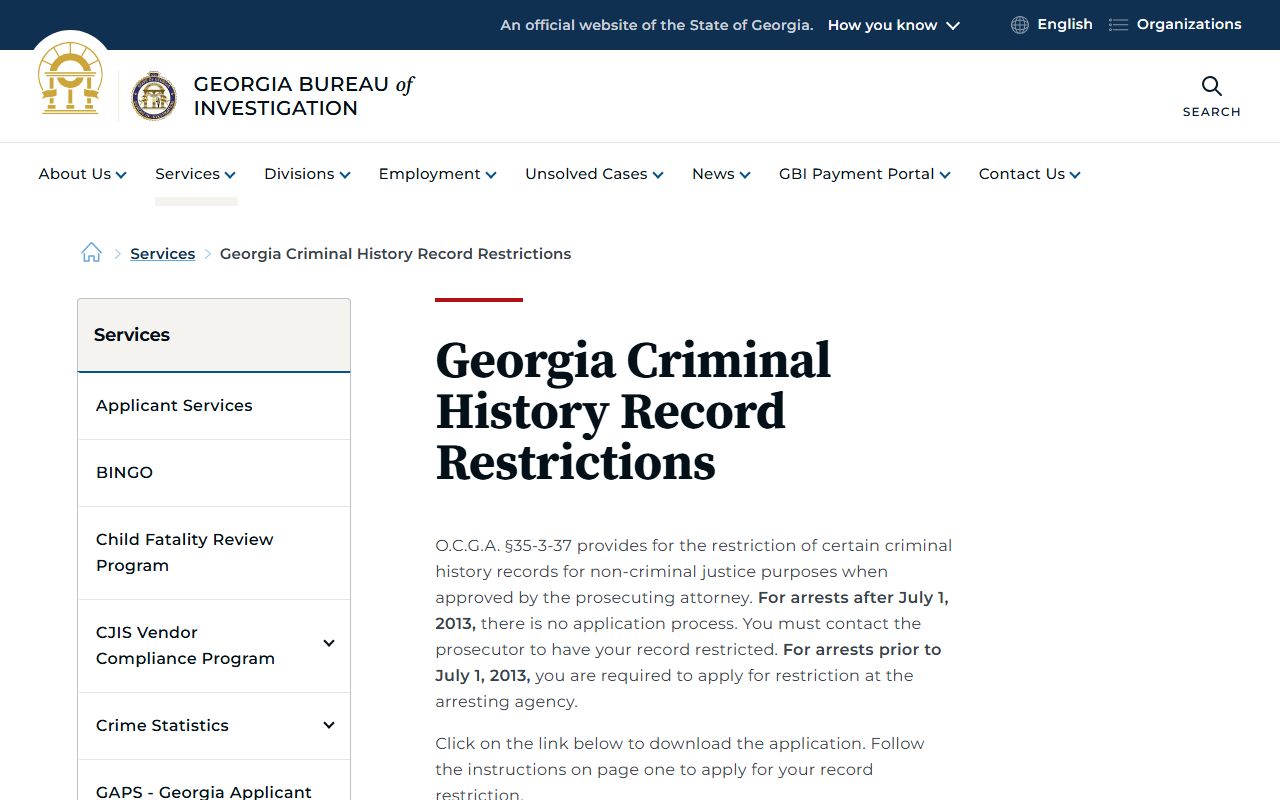
That restriction process is tied to criminal-history access and does not automatically make every court copy disappear.
Appling County Criminal Court Roles
The Brunswick Judicial Circuit District Attorney serves Appling, Camden, Glynn, Jeff Davis, and Wayne counties and is relevant to felony charging decisions, indictments, accusations, plea negotiations, victim-witness services, and post-July 1, 2013 record-restriction decisions where GBI directs people to contact the prosecutor. State Court misdemeanors are handled differently. Appling lists State Court Solicitor Graham F. Floyd at (912) 367-9000 for State Court matters.
The public defender is separate from records access. The Georgia Public Defender Council page for Appling County and the Brunswick Circuit lists the main office at 241 East Walnut Street, Jesup, GA 31598, phone (912) 427-9066, and names Stephen E. Tillman as Circuit Public Defender. Public defender representation is for eligible indigent defendants in criminal and juvenile cases. The public defender may appear in the case file as attorney of record, but the office is not the clerk and does not provide general public criminal record searches.
| Role | Criminal Case Function | Records Relevance |
|---|---|---|
| District Attorney | Felony prosecution in the Brunswick Judicial Circuit | Charging, plea, restriction, and disposition context. |
| State Court Solicitor | Misdemeanor and State Court prosecution | Filed accusations and misdemeanor outcomes. |
| Public Defender | Eligible defense representation | May appear as attorney of record. |
| Clerk | Maintains filed case records | Primary copy and certified-disposition route. |
The federal prosecutor image source is the U.S. Attorney's Office Southern District of Georgia district page.
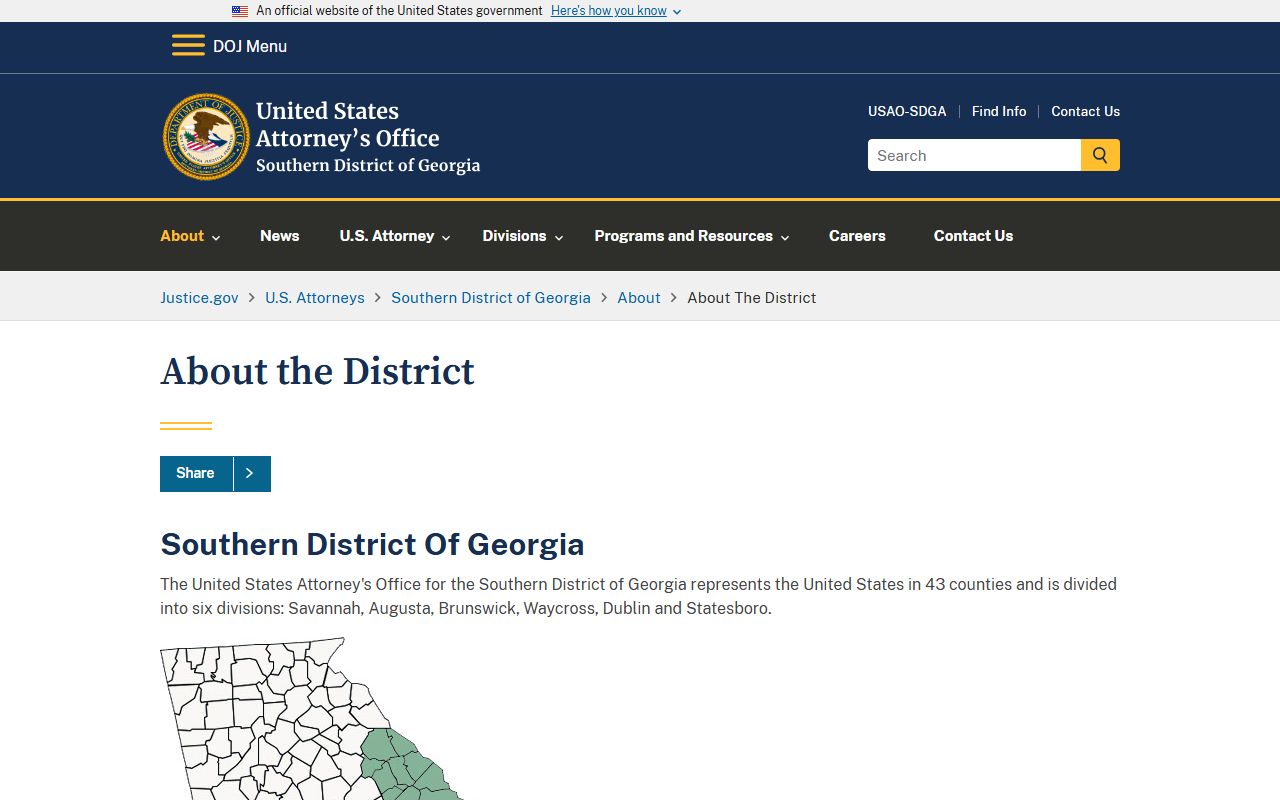
Federal prosecution is separate from Appling County Superior or State Court, but it can matter when conduct is charged in federal court.
Federal Criminal Records for Appling County
Appling County is in the Southern District of Georgia for federal court purposes. Federal criminal files are not kept by the Appling County clerk, even when the defendant lives in Appling County or the event happened there. Federal cases use the U.S. District Court system, CM/ECF, and PACER. Appeals from federal district court go to the Eleventh Circuit Court of Appeals.
Use federal sources only when the case is actually federal. A state felony, State Court misdemeanor, county traffic case, or Magistrate Court warrant is not found by searching PACER unless a separate federal prosecution or federal appeal exists. County criminal court records and federal criminal records are different systems with different clerks, case numbers, copy rules, and fees.
The federal docket image source is the PACER CM/ECF lookup for the Southern District of Georgia.
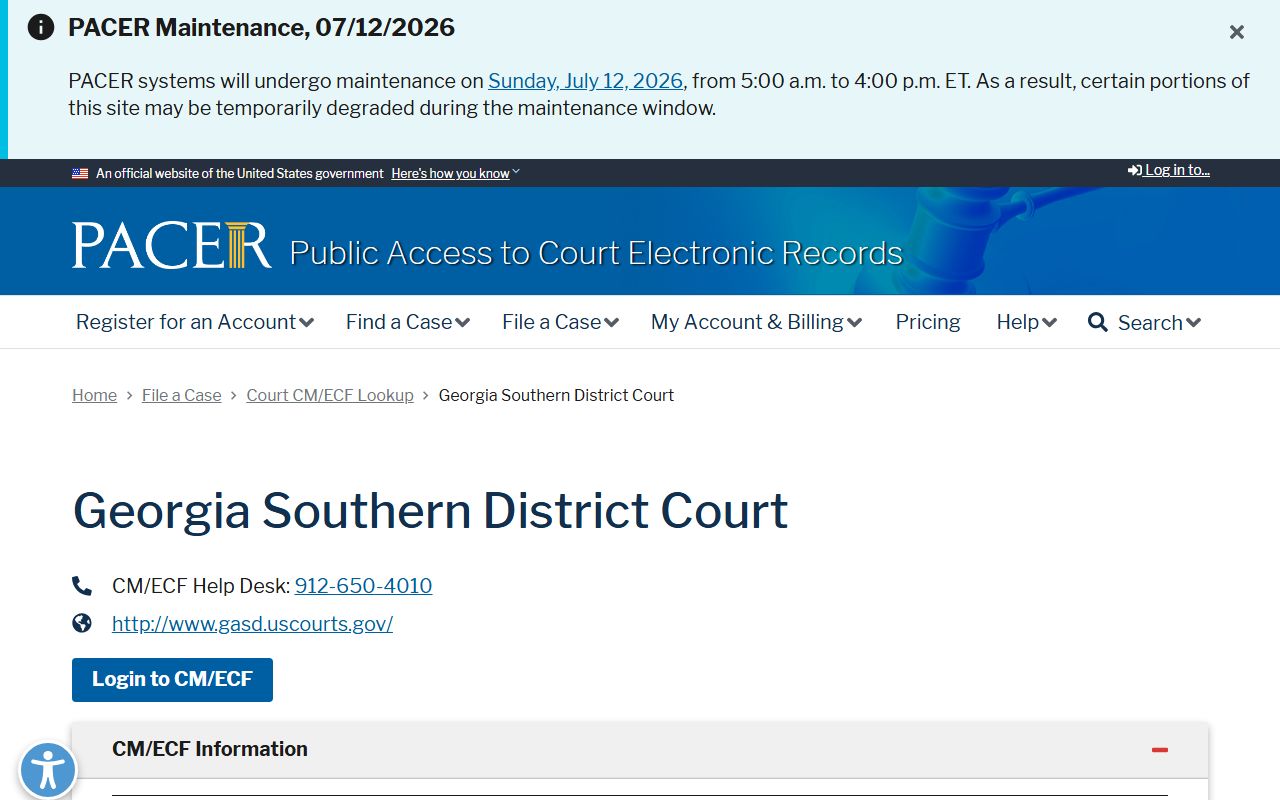
PACER is useful for federal cases, but it is not the local Appling County criminal court record portal.
The appellate image source is the Eleventh Circuit Court of Appeals, the federal appellate court for Southern District of Georgia cases.
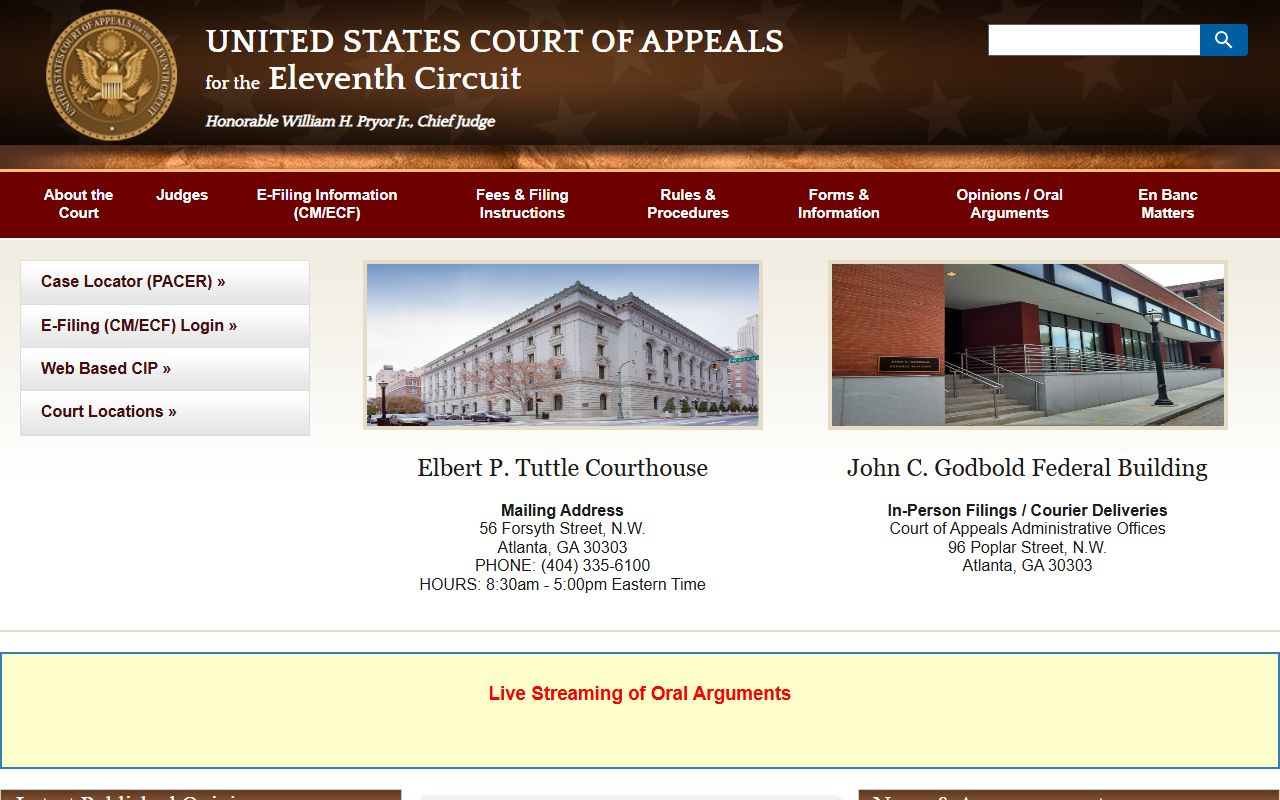
An appeal can create a separate appellate docket even when the original prosecution began in a trial court.
Sealed and Restricted Criminal Records
Georgia record law uses record restriction more often than the everyday word expungement. A restricted record is limited from ordinary public criminal-history access when the person qualifies under Georgia law. A sealed court record is hidden or limited by law or court order. These are not the same as a dismissed charge, and neither process should be assumed just because an online search does not show a case.
| Sealed | Restricted | |
|---|---|---|
| Basic effect | Limits public view of a court file or document. | Limits public access to eligible criminal-history information. |
| Authority | Court order, statute, confidentiality rule, or Rule 21 process. | Georgia criminal-history restriction law, including O.C.G.A. 35-3-37. |
| Where to start | Clerk or the court that sealed the file. | GBI guidance, prosecutor, or arresting agency depending on arrest date and case type. |
| Limit | May not erase every agency or historical copy. | May not remove all court, jail, news, or private copies. |
The statute source image comes from O.C.G.A. 35-3-37, Georgia's criminal-history restriction statute.
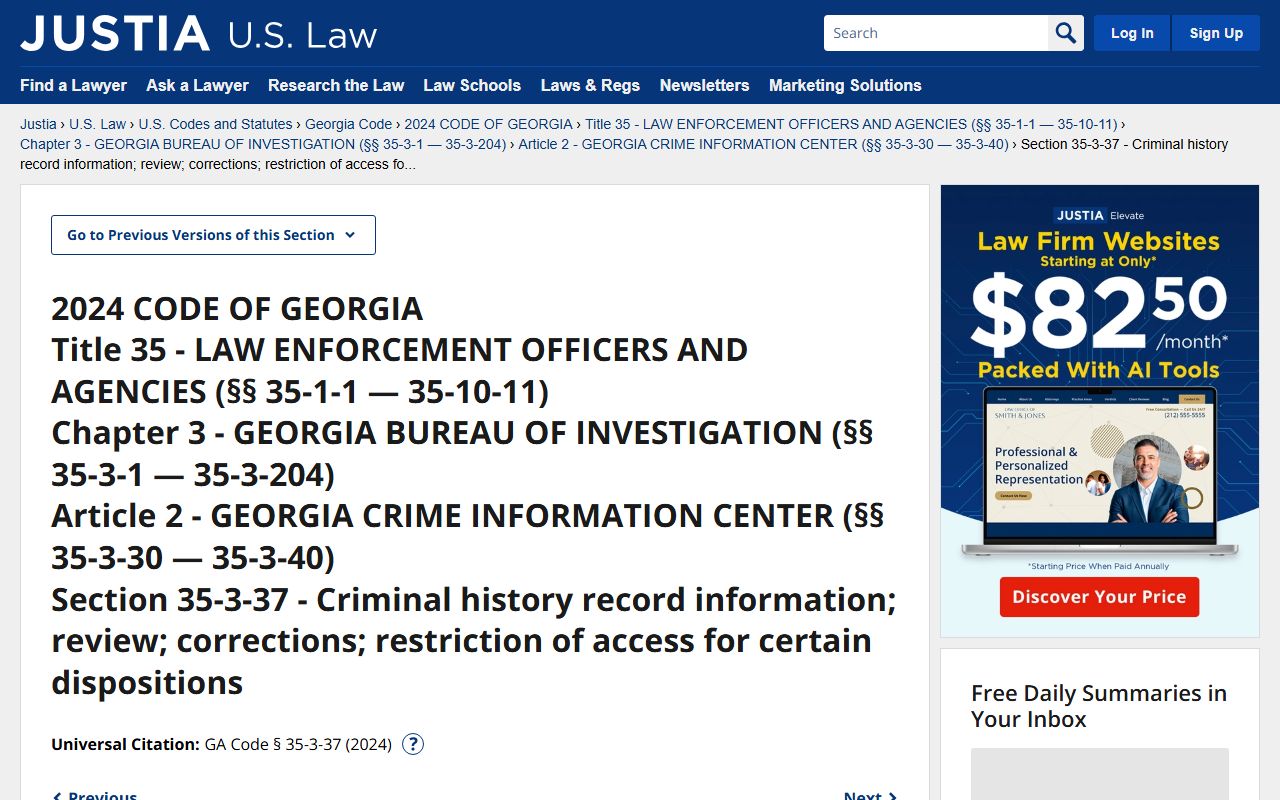
The statute is central when a dismissed or otherwise eligible criminal matter may qualify for restricted public access.
Public Access to Appling Criminal Records
Appling County criminal court records are generally public unless a statute, court rule, court order, or confidentiality rule limits access. Georgia's Open Records Act includes O.C.G.A. 50-18-70 and O.C.G.A. 50-18-71, but court files also follow court-record rules and clerk access practices. Uniform Superior Court Rule 21 is important for limiting access to court files when the legal standard is met.
Restricted categories include juvenile matters, sealed criminal records, eligible criminal-history restriction matters, active investigative records held by law enforcement, protected addresses, minor identifiers, financial account data, medical or mental-health material, and redacted personal identifiers. Adoption records are outside ordinary criminal access but show how Georgia court files can be closed by law. If a criminal case involves a minor, victim safety, or sealed warrant material, expect less public detail.
Key Access Point: Clerk records can prove court outcomes, while GBI or GCIC criminal-history systems answer different statewide history questions.
Appling County Criminal Records Office
The Clerk of Superior, State, and Juvenile Court is the main local office for filed Appling County criminal court records in Superior and State Court. Ask for the case by defendant name, case number, citation number, court type, approximate year, and the exact copy needed. For a formal use, request a certified disposition or certified judgment rather than relying on a screen print or partial docket.
Clerk of Superior, State, and Juvenile Court
69 Tippins Street, Suite 103
Baxley, GA 31513
(912) 367-8126
Monday-Friday, 8:00 a.m.-5:00 p.m.